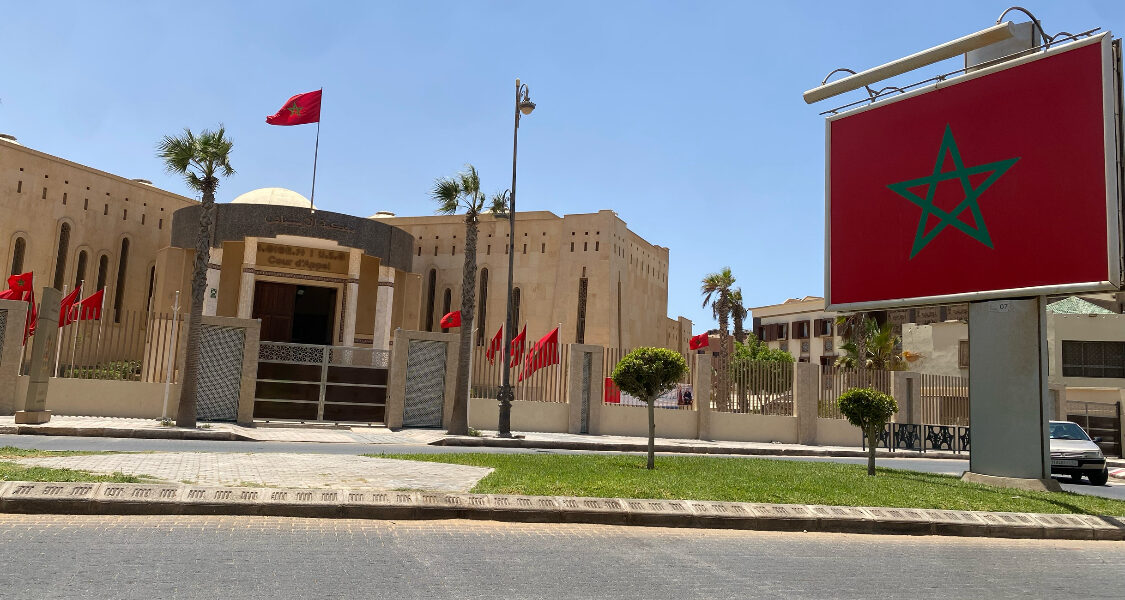
Morocco Must End Criminal Trials Conducted Without Legal Representation in Occupied Western Sahara
Adala UK expresses its grave concern over credible reports that the Criminal Chamber of the Court of Appeal in Laayoune, Occupied Western Sahara, has continued to hear criminal cases and impose custodial sentences during the nationwide strike of Moroccan lawyers, resulting in defendants being tried without the effective assistance of legal counsel.
The nationwide strike by lawyers across Morocco has severely disrupted the administration of justice, including in the Criminal Chamber of the Court of Appeal in Laayoune. Rather than postponing criminal proceedings until defendants could effectively exercise their right to legal representation, the court reportedly proceeded with hearings and delivered prison sentences despite the absence of defence lawyers.
The continuation of criminal proceedings under these circumstances constitutes a serious violation of the right to a fair trial and raises fundamental concerns regarding judicial independence, the rule of law, and Morocco’s compliance with its obligations under international law.
The right to legal representation is neither a procedural formality nor a discretionary safeguard. It is a fundamental human right and an indispensable guarantee of justice. Criminal convictions delivered in proceedings where defendants are denied effective legal assistance cannot be regarded as consistent with internationally recognised standards of due process.
Western Sahara remains a Non-Self-Governing Territory under Chapter XI of the Charter of the United Nations. The United Nations has consistently recognised that the decolonisation of the Territory has not yet been completed and that the Sahrawi people possess the inalienable and non-negotiable right to self-determination and independence, as affirmed in the Charter of the United Nations, General Assembly Resolution 1514 (XV) on the Granting of Independence to Colonial Countries and Peoples, and numerous subsequent United Nations resolutions. The Advisory Opinion of the International Court of Justice of 16 October 1975 further confirmed that no ties of territorial sovereignty existed that could affect the application of the principle of self-determination.
As the Occupying Power in Western Sahara, Morocco is bound by international humanitarian law, including the Fourth Geneva Convention of 1949, as well as its obligations under international human rights law. The Occupying Power has a legal duty to administer justice while fully respecting the rights of the protected population. It cannot invoke domestic legislation, institutional disputes, or exceptional circumstances—including the nationwide lawyers’ strike—to justify derogating from internationally recognised fair trial guarantees.
Morocco is also a State Party to the International Covenant on Civil and Political Rights (ICCPR). Article 14 guarantees every person charged with a criminal offence the right to a fair and public hearing before a competent, independent and impartial tribunal, as well as the right to defend themselves through legal assistance of their own choosing.
These obligations are reinforced by the Universal Declaration of Human Rights, the United Nations Basic Principles on the Role of Lawyers (Havana Principles, 1990), and the Basic Principles on the Independence of the Judiciary. Collectively, these standards require States to ensure that lawyers are able to perform their professional functions independently and that no individual is subjected to criminal proceedings without effective legal representation.
The reported continuation of criminal trials before the Criminal Chamber of the Court of Appeal in Laayoune during the lawyers’ strike has had particularly serious consequences for defendants in Occupied Western Sahara. Rather than adjourning proceedings until the right to defence could be guaranteed, the court reportedly continued with prosecutions and imposed custodial sentences. Such proceedings cast serious doubt on the legality, fairness, and legitimacy of the resulting convictions.
These developments are especially alarming in light of longstanding concerns expressed by United Nations human rights mechanisms regarding the human rights situation in Occupied Western Sahara, including concerns relating to fair trial guarantees, arbitrary detention, restrictions on fundamental freedoms, and the treatment of Sahrawi human rights defenders, journalists, and political activists. The reported denial of effective legal representation further reinforces the urgent need for enhanced international monitoring of judicial proceedings in the Territory.
Adala UK stresses that respect for fair trial guarantees in Occupied Western Sahara cannot be separated from respect for the Sahrawi people’s internationally recognised right to self-determination and independence. A people living under occupation must not be deprived of their fundamental legal safeguards while awaiting the completion of the United Nations decolonisation process. Respect for due process, judicial independence, and the rule of law is essential to protecting the rights and dignity of the Sahrawi people.
Adala UK therefore calls upon the Moroccan authorities to:
- Immediately suspend criminal proceedings where defendants are deprived of effective legal representation.
- Review all convictions and custodial sentences issued by the Criminal Chamber of the Court of Appeal in Laayoune during the lawyers’ strike where defendants were denied their right to defence.
- Guarantee that lawyers are able to perform their professional duties independently and without intimidation, interference, or reprisals.
- Fully comply with Morocco’s obligations under the International Covenant on Civil and Political Rights, the Fourth Geneva Convention, and all applicable rules of international humanitarian law and international human rights law.
Adala UK further calls upon the United Nations High Commissioner for Human Rights, the Special Rapporteur on the Independence of Judges and Lawyers, the Special Rapporteur on the Situation of Human Rights Defenders, the Working Group on Arbitrary Detention, and all relevant United Nations Special Procedures to closely monitor these developments, investigate the reported violations, and engage with the Occupying Power to ensure full compliance with international law.
The international community also bears a responsibility to ensure that the decolonisation process of Western Sahara is completed in accordance with the Charter of the United Nations and the principle of self-determination. Lasting peace, justice, and stability cannot be achieved while the Sahrawi people continue to be denied the opportunity to freely determine their political future.
Justice cannot exist where the right to defence is denied. The denial of effective legal representation not only violates international human rights law and international humanitarian law but also deepens the ongoing denial of the Sahrawi people’s fundamental rights, including their inalienable right to self-determination and independence.