Adala UK: Orange Must Remove Advertising That Depicts Occupied Western Sahara as Part of Morocco
Adala UK is calling on Orange Group and Orange Morocco to immediately remove advertising displayed in the occupied territory of Western Sahara which depicts the territory as part of Morocco and merges Western Sahara into the Moroccan map.
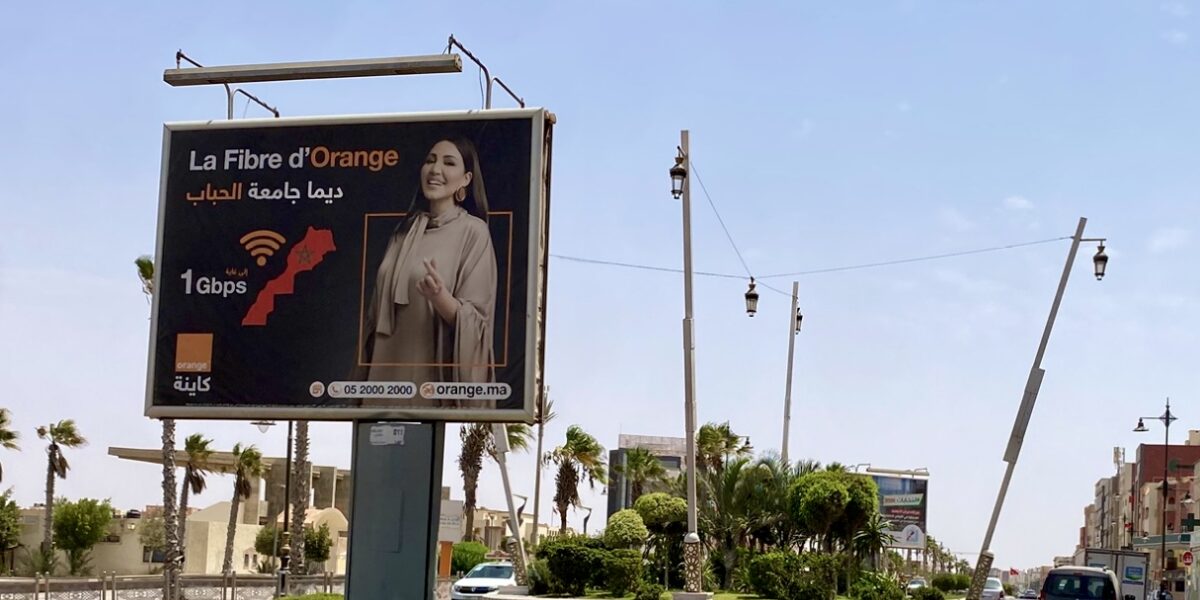
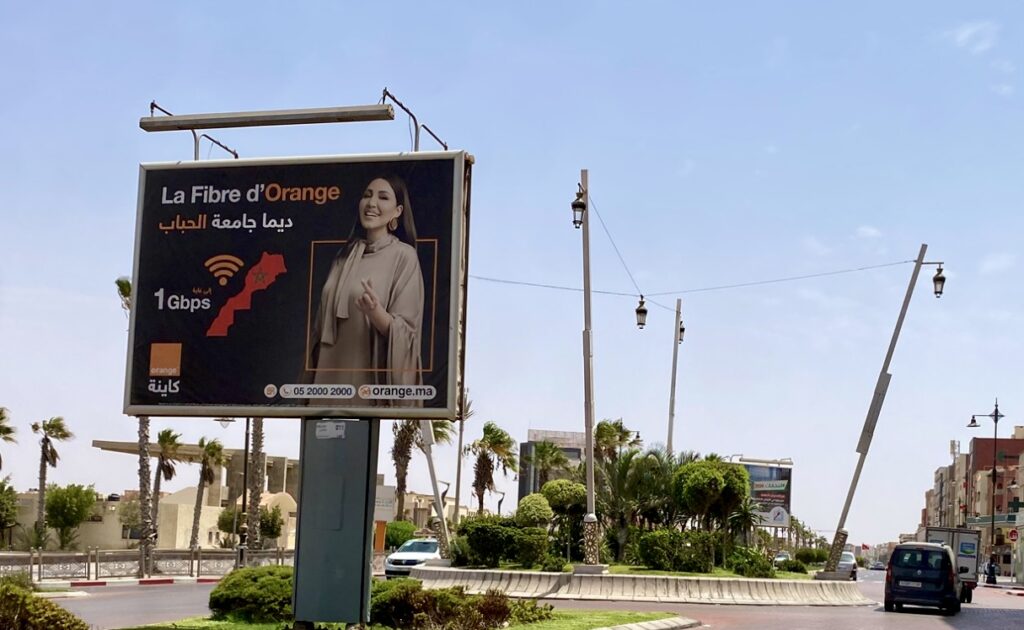
Adala UK activists in the occupied areas of Western Sahara have photographed and documented Orange-branded advertising in public spaces in which the territory appears to be incorporated into Morocco without a clear distinction between Western Sahara and the Kingdom of Morocco.
Adala UK considers this matter to be substantially more serious than an ordinary advertising or graphic-design issue. The representation concerns a territory whose international status remains unresolved, which remains listed by the United Nations as a Non-Self-Governing Territory, and whose decolonisation has not been completed.
The central issue is therefore straightforward: Orange must not use commercial advertising to present Morocco’s territorial claim over Western Sahara as an established and settled international fact.
Adala UK is calling for the immediate removal and correction of the relevant advertising, a comprehensive review of Orange’s cartographic and promotional practices, and a serious reassessment of the company’s commercial activities in Western Sahara.
The facts concerning Western Sahara are not a matter of corporate opinion
Adala UK wishes to make the position particularly clear.
The organisation is not asking Orange to adopt a particular political opinion.
Adala UK is pointing to an established international framework concerning Western Sahara.
Western Sahara remains included on the United Nations list of Non-Self-Governing Territories. The territory has not been removed from the UN decolonisation framework, and its final status has not been settled through an internationally agreed process giving effect to the right of the Sahrawi people to self-determination.
These are not matters created by Adala UK.
They are part of the international record concerning Western Sahara.
Consequently, Orange cannot reasonably treat the distinction between Morocco and Western Sahara as merely a political preference expressed by a civil-society organisation.
When Orange publishes or displays a map that incorporates Western Sahara into Morocco without distinction, the company is representing a disputed territorial claim as though it were an established geographical and legal reality.
Adala UK considers that representation unacceptable.
Adala UK activists have documented Orange advertising in the occupied territory
Adala UK activists operating in the occupied areas of Western Sahara have documented Orange advertising which visually incorporates Western Sahara into the Moroccan map.
Photographs taken by Adala UK activists show advertising material displayed in public areas in which the geographical representation does not distinguish Western Sahara from Morocco.
Adala UK has retained the photographic documentation as part of its monitoring of commercial representations and corporate activity relating to Western Sahara.
The significance of this evidence is particularly clear because the advertising has been documented inside the occupied territory itself.
This is not simply an issue concerning how Morocco is marketed to consumers abroad.
It concerns how the territory of Western Sahara is represented to people living in the territory and to the wider public who encounter Orange’s advertising there.
Adala UK considers the incorporation of Western Sahara into Morocco in such advertising to be a form of territorial erasure.
A company operating in an internationally disputed and decolonisation-related context has a responsibility to ensure that its commercial communications do not erase the distinction between the territory and the state claiming it.
A commercial map cannot settle a territorial question
Adala UK rejects any suggestion that the issue can be dismissed as a minor cartographic error.
Maps communicate geographical and political information.
When a company chooses to represent an entire territory within the borders of another state, without qualification or distinction, that representation communicates something to the public.
In the case of Western Sahara, the message is particularly significant because Morocco’s claim to the territory remains contested and the territory remains within the United Nations decolonisation framework.
Adala UK therefore considers it entirely inappropriate for Orange to use a map which visually communicates that Western Sahara is simply another part of Morocco.
Orange has no mandate to determine the territorial status of Western Sahara.
Nor does an Orange advertising department have the authority to resolve questions which remain within the international legal and political framework.
The appropriate corporate response is therefore not to take a political position, but to avoid prejudging the issue.
The United Nations position cannot simply be ignored
Adala UK draws particular attention to the continuing United Nations status of Western Sahara.
The territory has been listed by the United Nations as a Non-Self-Governing Territory since 1963, when it was under Spanish administration.
Its continued presence on the UN list demonstrates that the international decolonisation process concerning the territory remains unresolved.
Adala UK considers this distinction essential.
A territory that remains within the UN decolonisation framework cannot responsibly be represented by a multinational corporation as though its status had already been conclusively settled in favour of another state.
The fact that Morocco administers and controls large parts of the territory does not, by itself, transform the international status of the territory or settle the question of sovereignty.
Adala UK therefore calls on Orange to reflect the international status of Western Sahara in its commercial representations rather than reproducing a territorial claim as an established fact.
The International Court of Justice did not establish Moroccan sovereignty
Adala UK also draws attention to the Advisory Opinion of the International Court of Justice of 16 October 1975 concerning Western Sahara.
The Court examined the legal ties presented to it in relation to Morocco and the territory.
The Court found that the materials and information before it did not establish a relationship of territorial sovereignty between Western Sahara and the Kingdom of Morocco.
The Court also concluded that the legal ties identified did not affect the application of the principle of self-determination to the people of Western Sahara.
This legal history is directly relevant to the way the territory is represented.
Adala UK is not asking Orange to interpret the Advisory Opinion as a court would.
The point is considerably simpler.
Orange should not use its advertising to communicate as an established legal fact something that the International Court of Justice did not establish.
A commercial map cannot replace international law.
Corporate branding cannot confer sovereignty.
And advertising cannot determine the outcome of a decolonisation process.
European law also recognises the distinction between Western Sahara and Morocco
Adala UK further draws attention to the jurisprudence of the Court of Justice of the European Union concerning Western Sahara.
In cases concerning the application of EU-Morocco agreements, the Court has treated Western Sahara as territorially distinct from Morocco for the purposes of EU law.
This distinction is important for a European multinational such as Orange.
Adala UK considers that an international corporation with substantial European institutional and commercial connections should be fully aware that Western Sahara cannot simply be treated as legally identical to Morocco in every context.
The European legal position provides further reason for Orange to exercise particular care when representing the territory in its commercial communications.
The distinction between Morocco and Western Sahara is not an invention of Adala UK.
It is reflected in the international and European legal framework.
The Spanish billboard creates a question of corporate consistency
Adala UK’s intervention follows the controversy surrounding an Orange Morocco advertising billboard installed on the AP-7 motorway between Elche and Valencia in Spain.
According to reports published in Spain, Orange Morocco committed to removing the billboard following objections concerning the depiction of Western Sahara within the map of Morocco.
The advertisement promoted Orange services using the slogan:
“Explore Morocco with unlimited data, with Orange network.”
Reports indicated that the map used in the advertising material incorporated Western Sahara into Morocco.
Following a formal complaint by the representation of the Frente Polisario in Spain, Orange Morocco reportedly agreed to remove the billboard.
Adala UK notes this reported action because it establishes an important question of corporate consistency.
If Orange recognises the need to correct a representation of Western Sahara in Spain, the same standard must apply to Orange advertising displayed in the occupied territory of Western Sahara.
There can be no credible justification for one standard in Spain and another standard in Western Sahara.
Why should the standard be different in Western Sahara?
Adala UK is therefore putting a direct question to Orange Group and Orange Morocco:
Why should a map depicting Western Sahara as part of Morocco be corrected in Spain but remain on display in the occupied territory itself?
The geographical location of the advertisement cannot determine whether the representation is responsible.
Indeed, the need for accuracy is arguably even greater when the advertisement is displayed inside the territory whose status is being represented.
Sahrawi communities should not be expected to accept the public display of corporate advertising which visually incorporates their territory into another state’s map.
Adala UK considers that applying different standards depending on the location of the advertisement would amount to an unacceptable double standard.
Orange must not become a vehicle for territorial normalisation
Adala UK is particularly concerned about the cumulative effect of commercial imagery.
A single advertisement does not determine the status of Western Sahara.
However, repeated maps, billboards, posters, websites, applications and other commercial representations can gradually normalise a particular territorial narrative.
When Western Sahara is repeatedly shown as part of Morocco, the distinction between the two territories can disappear from public perception.
An unresolved territorial claim can begin to appear settled.
A process of decolonisation can become invisible.
And the existence and rights of the Sahrawi people can be marginalised from the public representation of their own territory.
Adala UK will not accept the use of international corporate branding as a mechanism for such normalisation.
Orange’s commercial interests cannot take precedence over the need for responsible representation.
Commercial activity does not determine sovereignty
Adala UK also rejects any implication that commercial presence can be treated as evidence that the territorial question has been settled.
The presence of telecommunications infrastructure does not determine sovereignty.
The provision of commercial services does not determine sovereignty.
Advertising does not determine sovereignty.
Investment does not determine sovereignty.
And corporate branding certainly does not determine sovereignty.
The status of Western Sahara must be addressed through the appropriate international framework.
Adala UK therefore calls on Orange to ensure that its commercial activities do not contribute to the creation of an impression that Morocco’s sovereignty over Western Sahara has already been internationally established.
Orange should conduct a full review of its activities in Western Sahara
Adala UK calls on Orange Group and Orange Morocco to conduct an immediate and comprehensive review of their activities in Western Sahara.
The review should cover advertising and marketing, maps, websites, mobile applications, digital campaigns, promotional material, commercial documentation, telecommunications infrastructure, partnerships, investments and other activities undertaken under the Orange name.
The review should examine whether any of these activities:
- erase the distinction between Western Sahara and Morocco;
- contribute to the normalisation of Morocco’s territorial claim;
- disregard the international status of Western Sahara;
- fail to take the rights and interests of the Sahrawi people into account; or
- contribute to the consolidation of the existing territorial situation.
Adala UK considers such due diligence a basic requirement of responsible corporate conduct in a territory with an unresolved international status.
Orange should not expand activities that reinforce the existing territorial situation
Adala UK calls on Orange to refrain from expanding activities in Western Sahara where those activities contribute to the normalisation or consolidation of Morocco’s control over the territory.
The organisation further calls on Orange to reassess existing activities where there is a demonstrable connection between those activities and the reinforcement of the territorial status quo.
Adala UK considers that commercial expansion cannot be separated from its wider consequences when it occurs in a territory undergoing an unresolved decolonisation process.
The rights and interests of the Sahrawi people must not be treated as secondary to commercial convenience.
Respect for the Sahrawi people
Adala UK emphasises that Western Sahara is not simply a geographical space.
It is the homeland of the Sahrawi people, whose right to self-determination remains central to the international framework concerning the territory.
Corporate decisions concerning the territory cannot responsibly proceed on the assumption that the political question has already been settled.
Adala UK therefore calls on Orange to take the rights and interests of the Sahrawi people into account when assessing its activities in Western Sahara.
The organisation also calls for meaningful engagement with Sahrawi civil society and human-rights actors concerning the impact of corporate activities and representations in the territory.
Adala UK’s demands to Orange
Adala UK calls on Orange Group and Orange Morocco to take immediate action.
The organisation demands:
1. The immediate removal of all Orange advertisements that incorporate Western Sahara into Morocco.
2. The correction of all Orange maps that present Western Sahara as an undisputed part of Morocco.
3. An investigation into the advertising documented by Adala UK activists in the occupied territory.
4. A clear explanation of how the relevant advertisements were designed, authorised and distributed.
5. A comprehensive review of Orange Morocco’s advertising and promotional campaigns.
6. A review of digital maps, websites, applications and online advertising.
7. The adoption of clear internal standards for the representation of Western Sahara.
8. The application of the same standards across the Orange Group, including Spain, Morocco and Western Sahara.
9. A comprehensive assessment of the human-rights and legal implications of Orange’s activities in Western Sahara.
10. An end to activities that contribute to the normalisation or consolidation of Morocco’s territorial claim.
11. No expansion of activities that may reinforce the existing territorial situation at the expense of the rights of the Sahrawi people.
12. A formal public response from Orange Group and Orange Morocco to the concerns raised by Adala UK.
Adala UK rejects the idea that these concerns are merely political
Adala UK is aware that Orange may attempt to characterise concerns regarding Western Sahara as political disagreement.
That characterisation would fail to address the substance of the issue.
The relevant facts concern the United Nations status of the territory, the unfinished decolonisation process, the principle of self-determination, the Advisory Opinion of the International Court of Justice and relevant European jurisprudence.
They also concern photographic evidence collected by Adala UK activists showing how Orange advertising represents the territory on the ground.
These matters cannot simply be dismissed as an expression of political preference.
Adala UK is calling on Orange to distinguish between political advocacy and responsible corporate conduct.
A company does not have to endorse a political position in order to refrain from presenting a disputed territorial claim as settled fact.
Adala UK expects the same response in Western Sahara as in Spain
The reported decision by Orange Morocco to remove the disputed billboard in Spain now provides Orange with an opportunity to demonstrate consistency.
Adala UK welcomes any correction of misleading or disputed cartographic representations.
But a correction in Spain cannot be regarded as sufficient if similar representations remain in place in Western Sahara.
The issue is not resolved simply because one billboard is removed.
The underlying corporate practice must also be addressed.
Adala UK therefore calls on Orange Group to ensure that the correction made in Spain becomes part of a consistent worldwide policy concerning the representation of Western Sahara.
A responsibility that cannot be outsourced
Adala UK considers Orange Group ultimately responsible for ensuring that its brand is not used in ways that conflict with responsible corporate standards.
The company cannot simply attribute disputed representations to a local advertising agency, contractor or subsidiary and regard the matter as closed.
Where the Orange name appears on advertising, the public associates that material with the Orange brand.
Adala UK therefore expects Orange Group to exercise proper oversight over the use of its name and corporate identity.
The responsibility for accurate and responsible representation cannot simply be outsourced.
Adala UK will continue documenting the issue
Adala UK will continue to monitor and document Orange advertising and other corporate activities in the occupied areas of Western Sahara.
The organisation will continue to preserve photographic and documentary evidence concerning the representation of the territory and will continue to raise legitimate concerns through peaceful, lawful and evidence-based advocacy.
Adala UK considers transparency and corporate accountability essential when international companies operate in territories whose final status remains unresolved.
The organisation will therefore continue to scrutinise corporate representations that may contribute to the erasure or normalisation of the distinction between Western Sahara and Morocco.
A direct message to Orange Group
Adala UK’s message to Orange Group is unequivocal.
The status of Western Sahara is not determined by an Orange advertising department.
The territory cannot be incorporated into Morocco simply because a commercial map has been drawn that way.
A corporate advertisement cannot settle an international territorial question.
A telecommunications company cannot confer sovereignty through branding.
And commercial convenience cannot justify the erasure of the distinction between Western Sahara and Morocco.
Adala UK calls on Orange to recognise the facts, correct the advertising and ensure that its commercial activities do not contribute to the normalisation of Morocco’s territorial claim over Western Sahara.
One standard must apply
The reported events in Spain have created a clear test for Orange.
If Orange is prepared to remove advertising in Spain because it improperly depicts Western Sahara as part of Morocco, the company must apply the same principle in Western Sahara.
If Orange accepts that the map was inappropriate in Spain, it cannot reasonably maintain that an identical representation is appropriate in the occupied territory.
One company must mean one standard.
One corporate policy must apply across all markets.
There must be no double standard for Western Sahara.
Adala UK therefore calls on Orange Group to act consistently, transparently and responsibly.
Final statement
Adala UK calls for the immediate removal of Orange advertisements that merge Western Sahara into Morocco and for the correction of all comparable representations across Orange’s commercial platforms.
Adala UK further calls for a comprehensive review of Orange’s activities in Western Sahara and for the company to refrain from expanding activities that contribute to the normalisation or consolidation of Morocco’s control over the territory.
The issue is not whether Orange agrees with Adala UK.
The issue is whether Orange is prepared to respect the international framework surrounding Western Sahara and to ensure that its commercial activities do not prejudge the future status of the territory.
Western Sahara remains within the United Nations decolonisation framework.
Its final status remains unresolved.
The right of the Sahrawi people to self-determination remains central to the international question.
The International Court of Justice did not establish Moroccan territorial sovereignty over Western Sahara.
European judicial decisions have recognised the distinct status of Western Sahara from Morocco in relevant legal contexts.
And Adala UK activists have documented Orange advertising in the occupied territory which visually merges Western Sahara with Morocco.
These facts require action.
Adala UK therefore calls on Orange to remove the advertisements, correct the maps, review its activities and apply the same standard in Western Sahara that it has reportedly accepted in Spain.
Western Sahara must not be erased from the map.
The Sahrawi people must not be erased from the question of their own territory.
And commercial advertising must not be allowed to present an unresolved territorial claim as an established international fact.
Adala UK calls on Orange to act accordingly.